
compares plasma air purifiers and HEPA filters across filtration performance, safety, energy use, maintenance, costs of HEPA Filter Installing and Air Purification installing, and real-world applications to help you choose the best solution for your home.
If you’re looking to improve your home’s indoor air quality, explore our complete air purification services to find the right solution for your needs.
Plasma Air Purifier vs HEPA Filter: Key Differences
| Feature | Plasma Air Purifier | HEPA Filter |
|---|---|---|
| Particle Removal | Good | Excellent |
| Dust & Allergens | Moderate to Good | Excellent |
| Smoke Particles | Moderate | Excellent |
| VOC & Odor Control | Good | Limited |
| Filter Replacement | Usually Minimal | Required |
| Maintenance | Lower | Moderate |
| Ozone Risk | possible in Some Models | None |
| Operating Cost | Lower Long-Term | Ongoing Filter Costs |
| Best For | Odors, Whole-Home Systems | Allergies, Dust, Smoke |
The biggest difference is that HEPA technology physically captures particles, while plasma systems electrically charge airborne contaminants to help remove or neutralize them.
How Plasma Air Purifiers Work vs How HEPA Filters Work
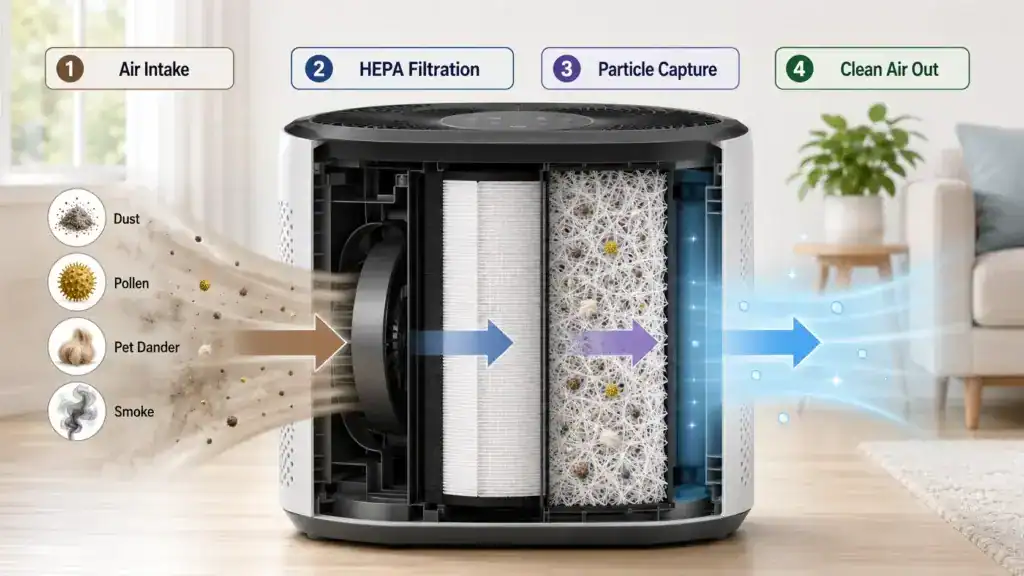
A HEPA filter works by forcing air through a dense filtration material that traps particles before cleaner air is released back into the room. This process is highly effective for removing dust, pollen, pet dander, and smoke particles.
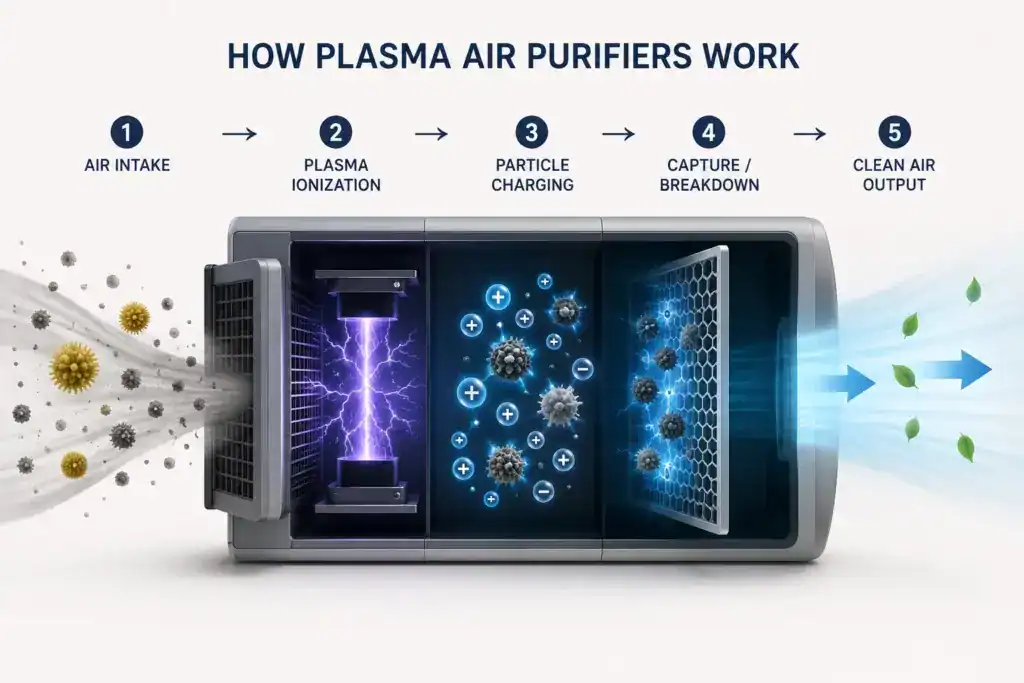
A plasma air purifier uses electrical energy to create charged ions or plasma fields. These charged particles interact with airborne pollutants, causing them to become easier to capture or break down. Many whole-home HVAC air purification systems use plasma technology as an additional layer of air treatment.
Many homeowners choose whole-home purification systems that integrate directly with existing heating and cooling system equipment.
Filtration Efficiency Comparison: Plasma vs HEPA
When filtration efficiency is the priority, HEPA filters generally outperform plasma systems.
True HEPA filters can capture 99.97% of particles as small as 0.3 microns. This includes many of the pollutants commonly found inside homes, such as pollen, dust mites, mold spores, and pet allergens.
Plasma technology can reduce airborne contaminants but typically does not provide the same measurable particle capture rate as a certified HEPA filtration system. For homeowners primarily concerned with particle removal, HEPA remains the benchmark.
A professionally air purification system installing can help reduce airborne contaminants while improving overall indoor comfort.
Airborne Particle Removal (Dust, Smoke, Allergens)
Dust, smoke, and allergens are among the most common indoor air quality concerns in Ontario homes.
HEPA filters are particularly effective for:
- Household dust
- Pet dander
- Pollen
- Mold spores
- Wildfire smoke particles
For example, during wildfire season, fine smoke particles can enter homes even when windows remain closed. A HEPA air purifier can help reduce these particles significantly, making indoor air more comfortable.
Plasma systems may help reduce airborne pollutants, but HEPA filtration typically provides more consistent particle removal.
Homes with older HVAC equipment may also benefit from regular servicing to AC maintenance healthy airflow.
Odor and VOC Removal: Plasma vs HEPA
This is one area where plasma technology often has an advantage.
HEPA filters are designed to capture particles, not gases. While some HEPA air purifiers include activated carbon filters for odor control, the HEPA filter itself does not remove VOCs (volatile organic compounds) or household odors.
Plasma air purifiers can help reduce:
- Cooking odors
- Pet odors
- Smoke smells
- Certain VOCs
- Chemical odors
If odors are your primary concern, plasma technology may offer benefits that a standard HEPA filter alone cannot provide.
Proper HVAC airflow also plays a significant role in distributing clean air throughout the home with air conditioning services.
Performance Against Viruses and Bacteria
Many homeowners want to know whether either technology can reduce viruses and bacteria in indoor air.
HEPA filters can capture many airborne particles that may carry bacteria or viruses. Plasma technology may help deactivate certain microorganisms depending on the system design.
However, neither technology should be viewed as a complete replacement for proper ventilation, cleaning practices, or public health recommendations.
For most homes, the goal is reducing airborne contaminants rather than eliminating all pathogens.
Indoor Air Quality Improvement: Which Is More Effective?
For overall indoor air quality improvement, the answer depends on the problem you are trying to solve.
Choose HEPA filtration if your main concerns are:
- Allergies
- Dust
- Smoke particles
- Pet dander
- Asthma triggers
Choose plasma technology if your main concerns are:
- Odors
- VOCs
- Whole-home HVAC integration
For many homeowners, a combination system provides the most complete solution.
Homes with forced-air furnaces can improve indoor air quality by combining filtration with properly furnace maintenance heating equipment.
Maintenance Requirements: Plasma Air Purifier vs HEPA Filter
Maintenance is an important factor when comparing air purification systems.
HEPA air purifiers require periodic filter replacement. Depending on the model and indoor air conditions, filters may need replacement every 6 to 24 months.
Plasma systems generally require less routine maintenance. Many models use washable components or filterless designs that reduce ongoing upkeep.
Homeowners who want minimal maintenance often prefer plasma technology, while those prioritizing filtration performance usually accept the need for HEPA filter replacement.
Filter Replacement Costs vs Filterless Systems
Ongoing costs can significantly affect the total ownership cost of an air purification system.
Typical HEPA filter replacement costs range from:
$50–$300 per year
depending on the system and replacement schedule.
Plasma air purifiers often have lower ongoing costs because many systems do not rely on disposable filters. While the initial purchase price may be higher, maintenance expenses are often lower over time.
When comparing systems, consider both the purchase price and long-term operating costs.
Energy Consumption Comparison
Both technologies are generally energy efficient.
Most residential HEPA air purifiers consume a modest amount of electricity, although larger units operating continuously will increase energy use.
Plasma systems are often designed to operate with low power consumption, particularly when integrated into HVAC systems.
For most homeowners, energy costs are unlikely to be the deciding factor between the two technologies.
Noise Levels: Plasma Air Purifier vs HEPA Filter
Noise can be an important consideration for bedrooms, offices, and living spaces.
HEPA air purifiers use fans to move air through the filter, which can generate noticeable sound at higher speeds.
Plasma systems often operate more quietly because they may require less airflow movement.
If noise reduction is a priority, compare manufacturer noise ratings before purchasing a system.
Safety Concerns with Plasma Air Purifiers (Ozone Emission)
One of the most common concerns about plasma technology involves ozone production.
Older ionizers and certain air purification technologies were known to produce ozone levels that could negatively affect indoor air quality. Modern plasma air purifiers have improved significantly, and many certified systems produce very low ozone levels.
When considering a plasma air purifier, look for models that comply with recognized safety standards and ozone emission regulations.
HEPA filters do not generate ozone and are generally considered one of the safest air filtration options available.
Best Use Cases for HEPA Filters
HEPA filtration is often the best choice for:
- Allergy sufferers
- Asthma sufferers
- Pet owners
- Homes with smokers
- Homes affected by wildfire smoke
- Bedrooms and nurseries
If reducing airborne particles is the primary goal, HEPA technology is typically the strongest option.
Best Use Cases for Plasma Air Purifiers
Plasma air purifiers may be a better fit for:
- Whole-home HVAC systems
- Odor control
- VOC reduction
- Large open spaces
- Commercial environments
- Homes seeking lower maintenance requirements
These systems are often used alongside traditional filtration rather than replacing it completely.
Combination Systems (HEPA + Plasma Technology)
Many modern air purification systems combine HEPA filtration and plasma technology.
This approach allows homeowners to benefit from:
- Strong particle removal
- Better odor control
- Improved VOC reduction
- Enhanced overall indoor air quality
For households dealing with multiple air quality concerns, combination systems often deliver the most balanced performance.
Allergy and Asthma Considerations
For allergy and asthma sufferers, HEPA filtration is generally the preferred choice.
Common triggers such as pollen, dust mites, mold spores, and pet dander are all particle-based contaminants that HEPA filters are specifically designed to capture.
For example, a homeowner with seasonal allergies may notice a significant reduction in symptoms after installing a high-quality HEPA air purifier in frequently used living spaces.
Plasma systems can contribute to cleaner air, but HEPA filtration remains the most widely recommended option for allergen control.
Which Is Better for Homes in High-Pollution Areas?
Ontario homeowners increasingly face air quality challenges from urban pollution and seasonal wildfire smoke.
In areas affected by elevated particulate pollution, HEPA filtration usually provides the greatest benefit because it directly captures fine airborne particles.
Plasma systems may still contribute to overall air quality improvement, but homes exposed to smoke or significant outdoor pollution generally benefit most from a high-performance HEPA filtration system.
Cost Comparison: Plasma Air Purifier vs HEPA Filter
Initial and long-term costs vary between technologies.
| Cost Category | Plasma Air Purifier | HEPA Filter System |
|---|---|---|
| Initial Cost | Moderate to High | Moderate |
| Maintenance Cost | Lower | Higher |
| Filter Replacement | Minimal | Regular |
| Long-Term Cost | Often Lower | Depends on Filters |
A lower purchase price does not always mean lower ownership costs. Consider maintenance, replacement parts, and expected lifespan when comparing systems.
Lifespan and Durability Comparison
Both technologies can provide many years of service when properly maintained.
HEPA air purifiers often require periodic filter replacement but can operate effectively for years.
Plasma systems may have fewer consumable components, which can contribute to longer service intervals.
Actual lifespan depends on usage patterns, maintenance quality, and product design.