
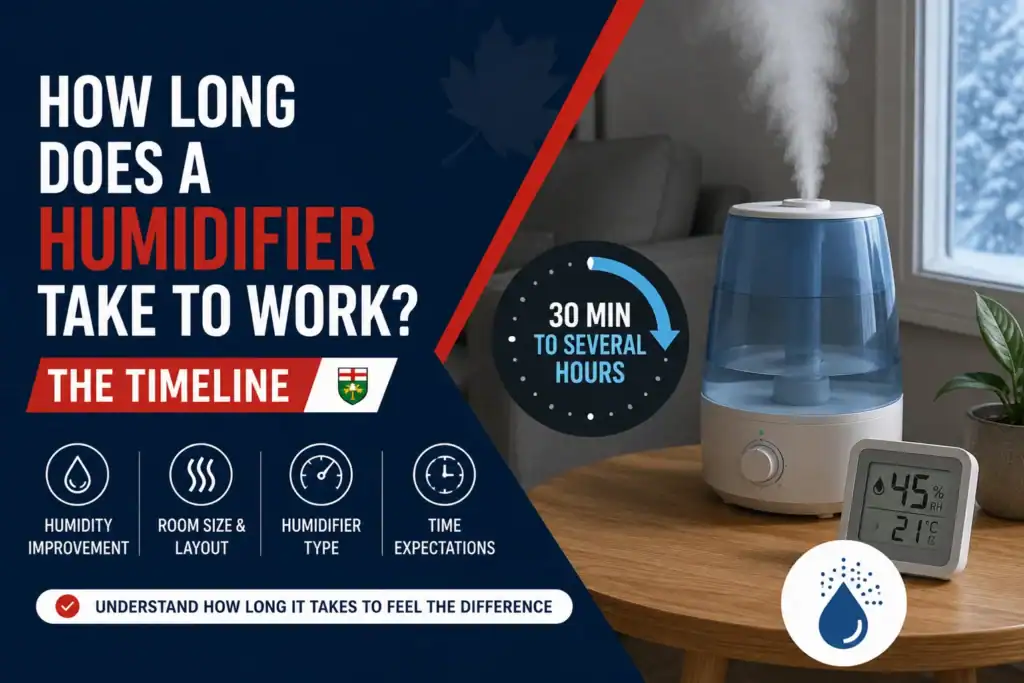
A humidifier can start adding moisture to the air within minutes, but it usually takes 30 minutes to several hours to noticeably increase the humidity in a room.
The exact time depends on the humidifier’s output, the size of the room, the starting humidity level, and how much moisture escapes.
Keep reading to learn what affects humidification speed, how long different types of humidifiers take to work, and how to tell whether your humidifier is working properly.
How Long Does It Take for a Humidifier to Work?
A humidifier starts working as soon as it begins releasing moisture into the air.
| Humidifier Output | Approximate Power | Recommended Room Size | Typical Time to Notice a Humidity Increase |
|---|---|---|---|
| 100–200 mL/hour | 10–20 W | Small room up to 100 sq. ft. | 1–3 hours |
| 200–300 mL/hour | 15–30 W | Small to medium room, 100–200 sq. ft. | 1–3 hours |
| 300–400 mL/hour | 20–40 W | Medium room, 150–300 sq. ft. | 1–4 hours |
| 400–500 mL/hour | 25–50 W | Medium to large room, 250–400 sq. ft. | 1–4 hours |
| 500–700 mL/hour | 30–70 W | Large room, 300–500 sq. ft. | 2–5 hours |
| 700–1,000 mL/hour | 40–100 W | Large room or open living area, 400–700 sq. ft. | 2–6 hours |
| 1,000–1,500 mL/hour | 50–150 W | Very large room or open-plan space, 600–1,000 sq. ft. | 3–8 hours |
| Whole-house humidifier | Varies by system | Entire home | Several hours to 24+ hours |
However, there is a difference between starting to work and noticeably increasing the humidity level.
Most humidifiers can begin adding moisture within minutes. But the room needs more time to absorb and distribute that moisture.
In general, you may notice a change in humidity within 30 minutes to a few hours.
A small bedroom with a properly sized humidifier may humidify relatively quickly. A large living room or open-plan space can take much longer.
If you are considering a whole-home solution, a professionally installed humidifier can work alongside your existing heating and cooling system to distribute moisture throughout the home.
tips: Use a hygrometer to check the humidity level before turning on your humidifier. Check it again after 30 minutes and one hour to see how quickly the humidity is changing
How Long Does It Take to Humidify a Room?
| Room Size | Typical Time to Noticeable Improvement |
|---|---|
| Small bedroom or office | 30 minutes to 2 hours |
| Medium bedroom | 1 to 4 hours |
| Large bedroom or living room | 2 to 6 hours |
| Large open-plan area | Several hours or longer |
These time ranges are only estimates. A powerful humidifier may humidify a large room faster than a small humidifier can humidify a smaller room.
The starting humidity level and ventilation also make a significant difference.
Tip: If you want to humidify one room as quickly as possible, keep the door closed. An open door allows moisture to spread into other areas.
How Long Does Each Type of Humidifier Take to Work?
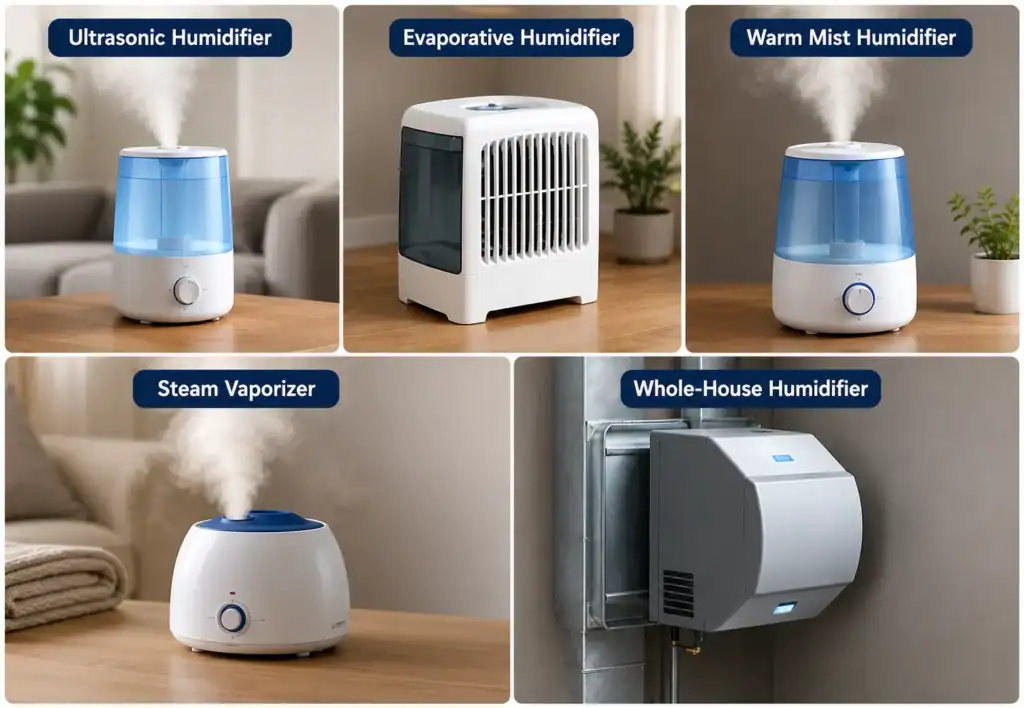
| Humidifier Type | How It Works | When It Starts Working | Typical Time to Notice a Difference |
|---|---|---|---|
| Ultrasonic Humidifier | Uses high-frequency vibrations to create a fine mist | Within minutes | 30 minutes to a few hours |
| Evaporative Humidifier | Uses a fan to draw air through a wet wick or filter | Within minutes | A few hours, depending on room conditions |
| Warm Mist Humidifier | Heats water before releasing moisture into the air | After the water heats up | 30 minutes to several hours |
| Steam Vaporizer | Boils water to produce steam | After the water reaches boiling temperature | Several hours, depending on room size |
| Whole-House Humidifier | Works with the HVAC system to distribute moisture throughout the home | As the HVAC system operates | Several hours or longer |
Different humidifiers use different methods to add moisture to the air. As a result, their startup time and performance can vary.
Ultrasonic Humidifiers
Ultrasonic humidifiers use high-frequency vibrations to create a fine mist. Most models begin producing mist within minutes of being turned on.
In a small or medium-sized room, you may notice a change in humidity within 30 minutes to a few hours. Ultrasonic humidifiers are also popular for bedrooms because many models operate quietly.
Evaporative Humidifiers
Evaporative humidifiers use a fan to pull air through a wet wick or filter. The air absorbs moisture before being released back into the room.
These humidifiers may take some time to create noticeable changes in humidity. However, their evaporation process naturally slows as the air becomes more humid.
This can help prevent the room from becoming excessively humid.
Warm Mist Humidifiers
Warm mist humidifiers heat water before releasing moisture into the air. They may take a short time to heat the water.
Once operating, they can begin adding moisture to the room. Depending on the model and room size, noticeable results may take 30 minutes to several hours.
Steam Vaporizers
Steam vaporizers boil water to produce steam. They need time to heat the water before producing steam.
After that, they gradually add moisture to the surrounding air. The time required depends on the size of the room and the unit’s output.
Whole-House Humidifiers
Whole-house humidifiers are designed to work with a home’s HVAC system. Instead of humidifying one room, they distribute moisture throughout the home.
Because they cover a much larger area, it can take several hours or longer to noticeably change humidity levels throughout the house.
If you are looking for a complete indoor air quality solution, humidification can also be considered alongside other air purification systems.
What Factors Affect How Quickly a Humidifier Works?
The same humidifier can work quickly in one room and slowly in another. Several factors determine how fast the humidity level increases.
Room Size
Room size is one of the biggest factors. A small humidifier can usually raise humidity faster in a bedroom or office than in a large living room.
A larger room contains more air. This means the humidifier needs to add more moisture to create a noticeable change.
Open-plan spaces can take even longer because moisture spreads across a larger area.
Humidifier Output
The amount of moisture a humidifier releases also affects how quickly it works. A high-output humidifier can add more moisture to the air in less time.
A small personal humidifier may work well near a desk or bedside table. However, it may not be powerful enough to quickly humidify an entire room.
Always check the manufacturer’s recommended room coverage before choosing a humidifier.
Tip: If your humidifier runs for hours but the humidity level barely changes, check whether it is designed for the size of your room.
Starting Humidity Level
The drier the room is, the longer it may take to reach a comfortable humidity level.
For example, raising humidity from 20% to 40% requires more moisture than raising it from 35% to 40%.
This is one reason rooms can take longer to humidify during dry winter weather.
Airflow and Ventilation
Open doors and windows allow humid air to escape. Fans, air conditioners, and heating systems can also move moisture away from the area.
As a result, the humidifier may be adding moisture while the room is losing it at the same time. This can make the humidifier seem less effective.
If your furnace is running frequently during the winter, regular furnace maintenance can help ensure that the heating system is operating properly and distributing air as intended.
Likewise, a properly maintained air conditioner can help maintain consistent indoor airflow during the cooling season. Learn more about air conditioner maintenance.
Tip: If you are trying to humidify one room, close unnecessary doors and windows while the humidifier is running.
Room Insulation
A well-insulated room usually holds moisture better. Drafty windows, gaps around doors, and poor insulation can allow humid air to escape.
If moisture is constantly leaving the room, your humidifier may need to run for much longer.
Humidifier Placement
Where you place the humidifier can also affect its performance. Place it on a stable, elevated, and water-resistant surface.
Make sure the mist outlet has enough space around it. Avoid placing the humidifier directly against a wall or behind furniture. The moisture needs space to circulate throughout the room.
How Long Does It Take for Popular Humidifier Brands to Work?
The brand itself does not determine how quickly a humidifier works.
The specific model and its moisture output are usually more important.
Two humidifiers from the same brand can have different output levels and room coverage.
When comparing models, look at:
- Moisture output
- Recommended room size
- Tank capacity
- Operating settings
- Automatic humidity controls
How Long Does a Levoit Humidifier Take to Work?
Many Levoit humidifiers begin producing mist shortly after being turned on. A properly sized model may produce noticeable humidity changes within a few hours.
Larger models with higher moisture output can generally affect larger spaces more effectively.
How Long Does a Honeywell Humidifier Take to Work?
Honeywell offers several types of humidifiers, including evaporative and whole-room models.
The time required to increase humidity depends on the specific model and room size.
A portable unit may take a few hours to noticeably change the humidity in a bedroom.
How Long Does a Dyson Humidifier Take to Work?
Dyson humidifiers are designed to distribute humidified air throughout a room.
The time required to reach the desired humidity depends on the room size, current humidity, and selected settings.
A larger room generally takes longer to humidify than a small bedroom.
How Long Does a Vicks Humidifier Take to Work?
Vicks humidifiers can begin adding moisture shortly after being turned on. In a small room, noticeable changes may occur within a few hours.
The exact time depends on the model, output setting, and room conditions.
Important: The brand name alone does not tell you how quickly a humidifier will work. Always check the model’s output and recommended room size.
Important: The brand name alone does not tell you how quickly a humidifier will work. Always check the model’s output and recommended room size.
How Can You Tell If Your Humidifier Is Working?
Visible mist is not always the best way to check whether a humidifier is working.
Some humidifiers produce visible mist, while others add moisture without creating an obvious cloud.
Here are the best ways to check.
Check the Humidity Level
A hygrometer is the most reliable way to measure humidity.
Take a reading before turning on the humidifier.
Then check the humidity again after 30 minutes or one hour.
If the humidity level gradually increases, your humidifier is working.
Check the Water Level
A working humidifier should normally use water over time.
The water level may decrease quickly on a high setting or slowly on a low setting.
If the water level never changes, there may be a problem with the unit.
Look for Mist or Steam
Visible mist or steam is a clear sign that some humidifiers are producing moisture.
However, the absence of visible mist does not always mean the humidifier is not working.
Evaporative humidifiers, in particular, may release moisture without producing visible mist.
Notice Changes in the Air
You may notice that the air feels less dry.
Dry skin, static electricity, or discomfort caused by dry air may also improve.
However, these signs are subjective.
A hygrometer gives you a more accurate measurement.
Tip: Place the hygrometer away from the humidifier’s direct mist stream. Otherwise, it may measure the air immediately around the unit instead of the average humidity in the room.
Why Is My Humidifier Not Increasing the Humidity?
If your humidifier has been running for hours but the humidity level has not changed, several problems may be responsible.
The Humidifier Is Too Small
The unit may not have enough output for the room.
Check the manufacturer’s recommended coverage area.
A small bedroom humidifier may not be powerful enough for a large living room.
The Room Is Too Large or Open
Open-plan spaces are more difficult for a portable humidifier to affect.
Moisture spreads across a larger area.
This can make the humidity level rise more slowly.
Moisture Is Escaping
Open windows and doors allow humid air to escape.
Heating and air-conditioning systems can also affect indoor humidity.
Try closing the room and checking whether the humidity begins to increase.
The Humidifier Is Dirty
Mineral deposits and buildup can affect performance.
A dirty filter, tank, or mist outlet may reduce the amount of moisture the humidifier releases.
Clean the unit according to the manufacturer’s instructions.
The Output Setting Is Too Low
Many humidifiers have multiple output settings.
If the unit is running on a low setting, it may simply need more time to increase humidity.
Increasing the output may help the room reach the desired level faster.
The Hygrometer Is Inaccurate
Sometimes the humidifier is working correctly, but the humidity reading is inaccurate.
If possible, compare the reading with another reliable hygrometer.
Note: A hygrometer placed directly next to a humidifier may give an unusually high reading because it is measuring the moisture closest to the unit.
How Can You Make Your Humidifier Work More Effectively?
A few simple changes can help your humidifier work more efficiently.
Choose the Right Size
Use a humidifier designed for the size of your room.
An undersized unit may run continuously without reaching the desired humidity level.
Keep Doors and Windows Closed
If you are humidifying one room, close unnecessary doors and windows.
This helps keep moisture inside the room.
Clean the Humidifier Regularly
Mineral buildup can reduce performance.
Regular cleaning helps keep the unit working properly.
Always follow the manufacturer’s cleaning instructions.
Use a Hygrometer
A hygrometer lets you see exactly how the humidity level changes.
This helps you determine whether the humidifier is working and when you can reduce or stop its operation.
Place the Unit Correctly
Place the humidifier where air can circulate around it.
Do not block the mist outlet with furniture, curtains, or walls.
Keep the unit on a stable, water-resistant surface.
Use the Recommended Water
Some humidifiers work best with distilled or purified water.
This can help reduce mineral buildup, especially in ultrasonic humidifiers.
Always follow the manufacturer’s recommendations for water type.
Tip: Do not simply set the humidifier to its highest setting and leave it running continuously. Monitor the humidity level and adjust the output as needed.
How Long Should You Run a Humidifier?
A humidifier may need to run for several hours to raise the humidity level.
However, there is no single run time that works for every room.
The ideal operating time depends on:
- The current humidity level
- Your target humidity level
- Room size
- Humidifier capacity
- Indoor heating and ventilation
Many people run a humidifier for several hours during the day or overnight.
The best approach is to monitor the humidity level with a hygrometer.
What Humidity Level Should You Aim For?
Many indoor environments are comfortable at approximately 30% to 50% relative humidity.
The ideal level may vary depending on the season and personal comfort.
The important thing is to avoid excessive humidity.
Running a humidifier continuously without monitoring the humidity level can add more moisture than the room needs.
Important: The brand name alone does not tell you how quickly a humidifier will work. Always check the model’s output and recommended room size.
Frequently Asked Questions
How quickly does a humidifier raise humidity?
A humidifier can begin adding moisture within minutes.
However, it may take 30 minutes to several hours to noticeably increase the humidity in a room.
How long does it take for a humidifier to work in a bedroom?
A properly sized humidifier may noticeably improve humidity in a bedroom within 30 minutes to a few hours.
A very dry room or a low-output humidifier may take longer.
Can a humidifier humidify a room overnight?
Yes, many humidifiers are designed to run for several hours or overnight.
Make sure the model is designed for extended operation and follow the manufacturer’s instructions.
A hygrometer can help you monitor the humidity while the humidifier is running.
Why does my humidifier take so long to raise humidity?
The humidifier may be too small for the room.
Other possible causes include open doors or windows, poor insulation, a dirty unit, or a low output setting.
Should I leave the door open when using a humidifier?
If you want to humidify one room quickly, keeping the door closed is usually more effective.
An open door allows moisture to spread into other areas.
Does a bigger humidifier work faster?
A larger humidifier often has a higher moisture output.
However, the most important factor is choosing a unit that is properly sized for the room.
How can I tell if my humidifier is working?
Use a hygrometer to check whether the humidity level increases.
You can also check whether the water level decreases and whether the unit produces mist or steam when applicable.
Can a humidifier make a room too humid?
Yes.
Excessive humidity can make a room uncomfortable and contribute to moisture-related problems.
Monitoring the humidity level helps prevent over-humidification.
Final Answer: How Long Does a Humidifier Take to Work?
A humidifier starts working within minutes, but it usually takes 30 minutes to several hours to noticeably increase the humidity in a room.
Small rooms generally humidify faster than large spaces.
The most important factors are the humidifier’s moisture output, room size, starting humidity level, and how much moisture escapes.
For the best results, choose a properly sized humidifier, keep doors and windows closed, clean the unit regularly, and monitor humidity with a hygrometer.
If you need a whole-home solution, a professionally installed humidifier can work with your existing HVAC system. For broader indoor air quality needs, you can also explore professional air purification installation.
The goal is not to run a humidifier for a specific number of hours.
The goal is to reach and maintain a comfortable humidity level without making the room excessively damp.