
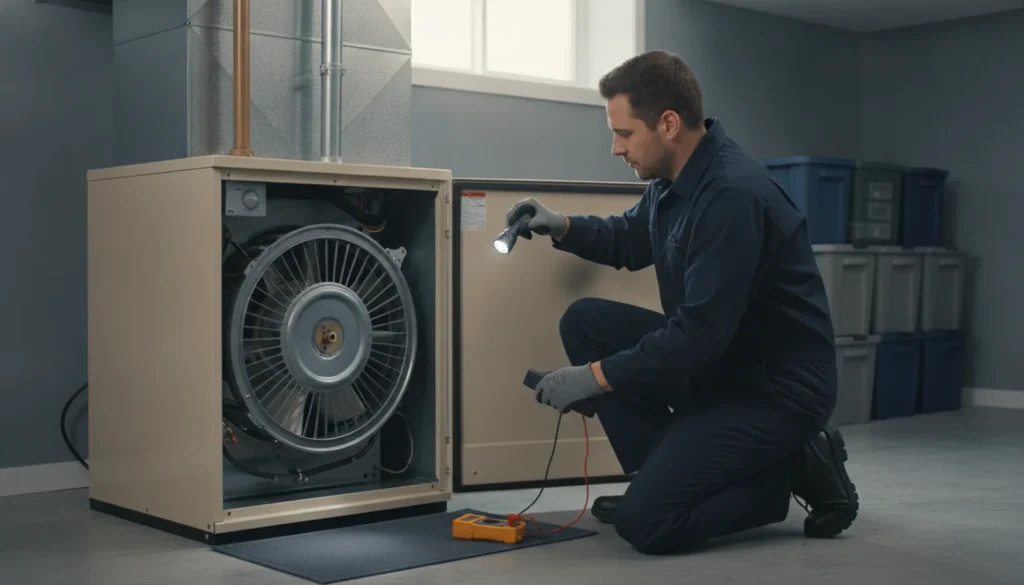
Your furnace makes a noise it has never made before, and then it stops making any noise at all. Somewhere in that cabinet is a motor that has decided fifteen winters was enough.
There are two of them in a modern high-efficiency furnace, and homeowners almost never know which is which until a technician is standing in the basement telling them. One moves heated air through your ducts. The other clears exhaust gas out of the burner before the furnace will even light. They cost different amounts, they fail in different ways, and they produce very different quotes.
This guide gives you the real furnace blower motor replacement cost and inducer motor cost in Canada in 2026, how to tell from the symptoms which one you are probably dealing with, why one quote can be $800 higher than another for what sounds like identical work, and the point at which fixing the motor stops making financial sense. Prices are ranges rather than a single number, because the honest answer depends on your furnace, your basement, and what time of night it failed.
How Much Does a Furnace Motor Replacement Cost in Canada?
In 2026, a furnace blower motor replacement in the Greater Toronto Area typically costs $450 to $1,300 installed for a standard PSC motor and $900 to $2,100 for an ECM. A draft inducer motor typically costs $500 to $1,400 installed. Both figures include parts, labour and the diagnostic, assume normal business hours and reasonable access, and exclude HST.
Those are wide ranges, and the width is the useful part. The motor itself is often the smaller half of your bill.
Furnace blower motor replacement cost by motor type
| Motor | Part | Labour | Typical installed total (CAD) |
|---|---|---|---|
| PSC blower motor | $150 – $450 | $200 – $600 | $450 – $1,300 |
| ECM blower motor | $400 – $1,200+ | $300 – $700 | $900 – $2,100 |
| Variable-speed ECM (integrated module) | $700 – $1,500+ | $350 – $800 | $1,200 – $2,400 |
| Draft inducer motor | $150 – $600 | $250 – $700 | $500 – $1,400 |
Assumptions: Southern Ontario, 2026, standard business hours, furnace accessible without dismantling ductwork, HST not included. Motor part prices track the wholesale ranges quoted across Canadian and North American suppliers; labour reflects GTA rates of $120 to $160 per hour and one to three hours on site.
Labour is not a padding line. A blower motor swap on an open, well-placed furnace is genuinely a one to two hour job. The same job on a furnace wedged into a finished-basement closet, where the blower assembly has to come out through a gap someone framed in 1998, is three hours and a bruised forearm.
What the diagnostic fee covers
Most Ontario contractors charge $100 to $150 to come out and diagnose, and in the GTA that is at the upper end of the range. That fee buys you a technician confirming which component actually failed, which matters more here than in most repairs, because the symptoms overlap.
Ask one question when you book: is the diagnostic credited toward the repair if I go ahead? Many companies apply it. Some do not. It is a $150 difference and it is worth thirty seconds on the phone.
Related parts replaced at the same time
Motors rarely fail in isolation, and a quote that includes one of these is not necessarily being padded.
| Part | Typical installed cost (CAD) | Why it comes up |
|---|---|---|
| Run capacitor | $150 – $450 | A weak capacitor is often what killed the PSC motor. Replacing the motor without it invites a repeat. |
| Blower wheel cleaning | $100 – $300 | A caked wheel makes the new motor work as hard as the old one did. |
| Pressure switch | $150 – $300 | Frequently misdiagnosed as the inducer motor, and vice versa. |
| Control board | $200 – $900 | Higher end on high-efficiency furnaces. An ECM failure can take the board with it. |
| Wiring or harness repair | $150 – $600 | Heat-damaged connectors near a seized motor. |
Blower Motor or Inducer Motor: Which One Failed?
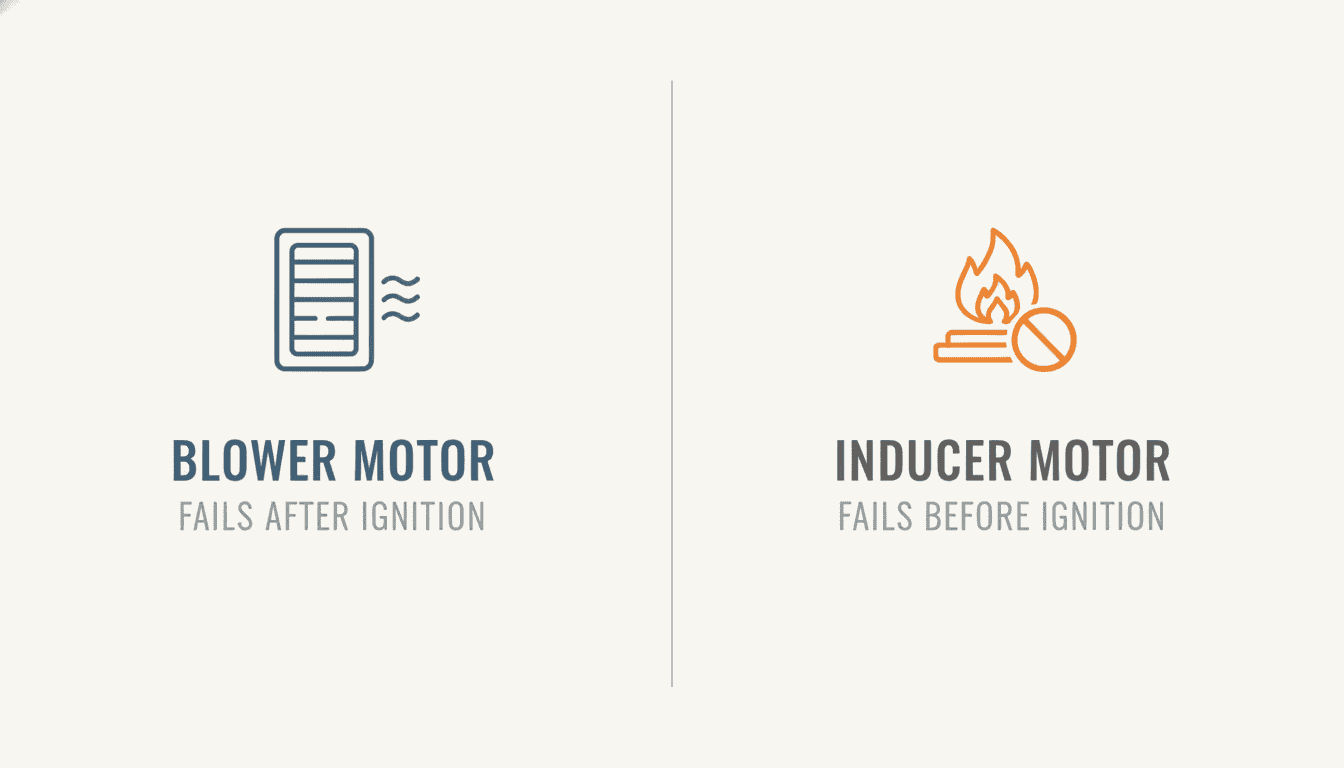
The quickest way to tell them apart is when the trouble happens. If your furnace lights and runs but little or no air comes out of the vents, suspect the blower motor. If your furnace never gets as far as lighting, and you hear a click, a hum, or a rattle from the exhaust side before it shuts down and tries again, suspect the draft inducer motor.
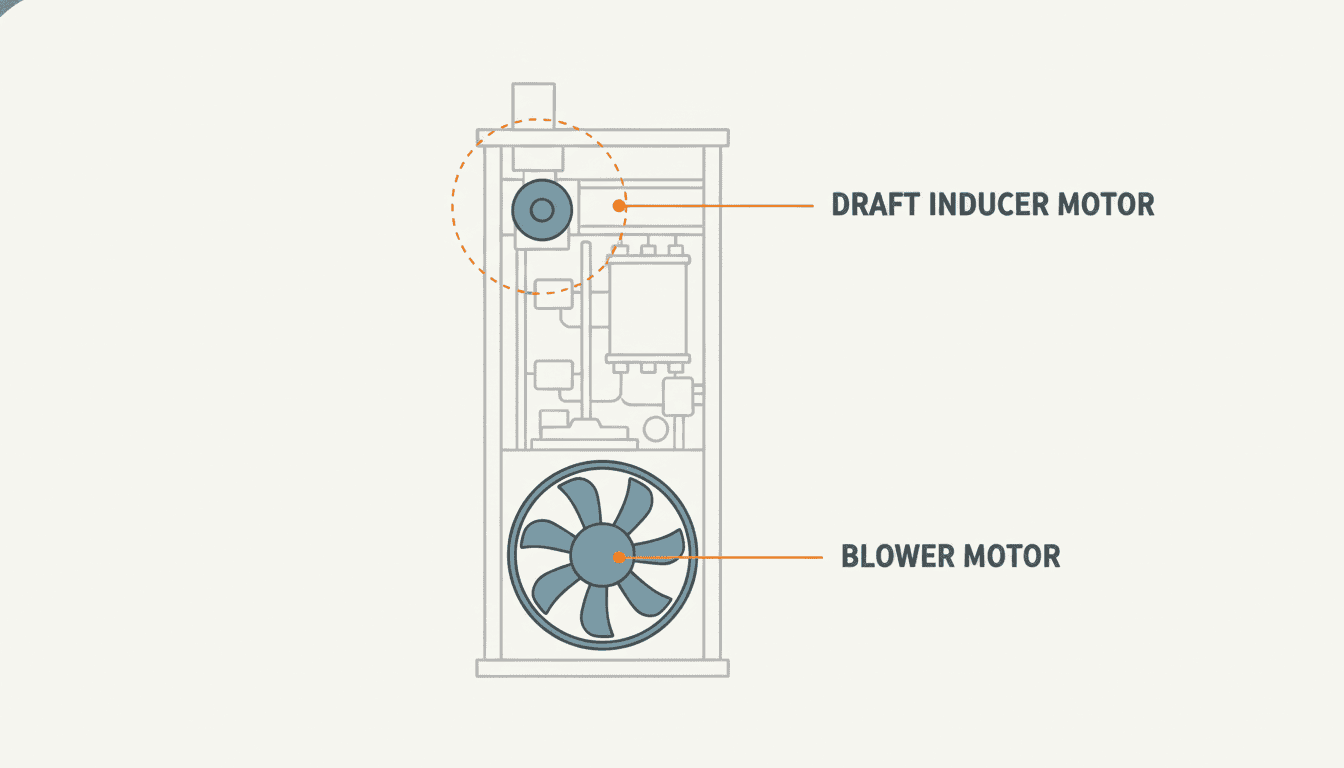
The blower motor is the large one. It sits in the bottom compartment and pushes heated air through your ducts into the house. When it goes, the furnace still fires, but the heat has nowhere to go, and the furnace will eventually shut itself down on a high-limit fault to avoid cooking its own heat exchanger.
The draft inducer motor is the small one, mounted up near the exhaust vent. Its job is to clear the combustion chamber of leftover gas and establish a draft before the burners are allowed to light. It is a safety interlock as much as a fan. If the furnace cannot prove the draft, it will not light. That is the system working correctly, even though it feels like the opposite.
Symptoms, and what they usually mean
| What you notice | Most likely | Also possible |
|---|---|---|
| Furnace runs, weak or no airflow at vents | Blower motor | Blocked filter, seized blower wheel |
| Loud grinding or squealing once heat is running | Blower motor bearings | Blower wheel out of balance |
| Burning smell while the fan is running | Blower motor overheating | Debris on the heat exchanger |
| Furnace clicks and hums but never lights | Inducer motor | Pressure switch, blocked vent |
| Rattling or whining near the exhaust pipe at startup | Inducer motor | Loose mounting gasket |
| Furnace tries three times, then locks out | Inducer motor or pressure switch | Blocked intake or exhaust |
| Breaker trips when heat calls | Either motor, shorted | Control board |
Why the pressure switch gets blamed for the wrong part
This is the most common misdiagnosis in furnace repair, and it costs homeowners real money.
The pressure switch is a small sensor that confirms the inducer motor is actually pulling a draft. If the inducer is weak but still spinning, the switch never closes, and the furnace reports a pressure switch fault. Replace the switch and the fault comes straight back, because the switch was telling the truth.
It also runs the other way. A blocked or ice-plugged exhaust vent produces the identical fault with two perfectly healthy parts. On a high-efficiency furnace venting out a sidewall, a January ice collar over the termination is a genuinely common cause. A technician who checks the vent before quoting a motor is doing you a favour.
PSC or ECM: Why Two Quotes Differ by $800
The largest variable in your bill is not labour and it is not the brand of your furnace. It is which of two motor technologies your furnace was built with.
A PSC motor (permanent split capacitor) is the older design. It runs at a fixed speed for each wired tap, it relies on a capacitor to start and hold torque, and it is mechanically simple. Parts run $150 to $450, and any competent technician can swap one without a laptop.
An ECM (electronically commutated motor) is a brushless DC motor with a small computer bolted to the end of it. It varies its speed continuously to match what the system is asking for, rather than jumping between fixed taps. Parts run $400 to $1,200 or more, and on many models the motor and its control module are sold as one assembly, so a failed $200 module means buying the whole thing.
What you get for the difference
An ECM runs at roughly 90% efficiency against 60% to 70% for a PSC. That gap matters most if you run your fan continuously for filtration or air circulation, where an ECM can cut annual motor running costs substantially. It also ramps up and down instead of slamming on, which is quieter and holds temperature more evenly across the house.
If your fan only runs when the furnace calls for heat, the efficiency gain is real but modest, and it will not pay back a $900 premium on its own.
PSC and ECM side by side
| PSC | ECM | |
|---|---|---|
| Speed control | Fixed taps | Continuously variable |
| Motor efficiency | 60% – 70% | Up to 90% |
| Part cost | $150 – $450 | $400 – $1,200+ |
| Installed cost | $450 – $1,300 | $900 – $2,100 |
| Needs programming | No | Yes, on most models |
| Typical in furnaces from | Pre-2010 | 2010 onward, and all variable-speed models |
Should you retrofit a PSC to an ECM?
Occasionally, and less often than the upsell suggests.
A retrofit makes sense if your furnace is relatively young, you run the blower continuously, and your ducts are in good shape. It does not make sense on a furnace already past twelve years, because you would be spending ECM money on a system you will replace before the savings arrive. A retrofit also needs the control board to speak to the new motor, which is not a given on older equipment.
The plain version: if your PSC motor fails on a furnace with real life left in it, ask what an ECM retrofit costs and what your fan runtime actually is. If your fan runs only on a call for heat, put the PSC back in.
What Makes One Quote Higher Than Another?
Four things, in descending order of impact.
Motor type and whether the part is an assembly. Covered above, and worth $500 to $900 on its own. On some high-efficiency models the inducer motor is only sold bolted to its housing, which turns a $200 part into a $500 one through no fault of anyone in your basement.
Brand and parts availability. An OEM motor for a common Goodman or KeepRite furnace is on a local supplier’s shelf this afternoon. A specific inducer assembly for a less common model may be two or three days out, and if you have no heat in February, that wait has a cost of its own. Aftermarket-equivalent motors are legitimate and cheaper, but ask whether using one affects your remaining manufacturer warranty before you agree.
Access. A furnace with clear working room on all sides is a straightforward job. A furnace in a tight utility closet, in a crawlspace, or with a water heater installed eighteen inches from the blower door, is not. This is a real cost and a reasonable one.
When you call. Evening, weekend and holiday rates typically add $150 to $400, and a genuine no-heat emergency call in a cold snap can push a routine blower motor replacement past $1,800. If the house is holding temperature and you have somewhere warm to be, booking the first available regular-hours slot is the single easiest way to reduce this bill.
Should You Replace the Motor or the Whole Furnace?
Three numbers decide this: the age of the furnace, the cost of the repair, and the cost of a replacement. If your furnace is under 10 years old, replace the motor. If it is over 15, get both quotes before deciding. If the repair costs more than half of a new furnace, replacing the motor is usually money spent on a system that will need replacing anyway.
A furnace in Ontario generally lasts 15 to 20 years. A blower motor lasts 10 to 20, typically around 15. An inducer motor lasts roughly 12 to 15. Those numbers overlap deliberately, because that overlap is exactly where this decision lives: the motor tends to fail right around the time the rest of the furnace is getting tired too.
The decision, by age
| Furnace age | Typical call | Reasoning |
|---|---|---|
| Under 10 years | Replace the motor | The furnace has most of its life ahead of it. Warranty may cover the part. |
| 10 – 15 years | Replace the motor, start planning | Usually still the right economics, but get a replacement quote so the next failure is not a surprise decision made in February. |
| Over 15 years | Get both quotes | Especially if the repair exceeds 50% of replacement, or if this is the second significant repair in two years. |
| Over 20 years, cracked heat exchanger, or repeated failures | Replace the furnace | A cracked heat exchanger is a safety condition, not a cost decision. |
For reference, a new high-efficiency furnace installed in Ontario generally runs several thousand dollars depending on size, efficiency tier and venting work. Our furnace installation cost guide for Ontario breaks that down by system and home, and if you want the lifespan question on its own, we cover how long a furnace lasts in Ontario separately.
Where rebates do and do not apply
There is no rebate for a motor repair. Rebate programs fund equipment upgrades that reduce energy use, not component replacements, so this will not offset your repair bill.
If the decision tips toward replacing the furnace, the position as of 4 September 2026 is worth knowing:
- Home Renovation Savings Program, delivered by Save on Energy with Enbridge Gas and the Government of Ontario, is the live province-wide program. Eligible cold-climate air-source heat pumps can attract $1,250 per ton up to $7,500 for homes heated by electricity, oil, propane or wood, and $500 per ton up to $2,000 for homes heated by Enbridge gas.
- Enbridge Home Efficiency Rebate Plus (HER+) has been closed to new participants since February 2024.
- The Canada Greener Homes Grant is closed. The Canada Greener Homes Loan remains available, offering up to $40,000 interest-free over a 10-year amortization for qualifying retrofits.
Rebate programs change and expire, so confirm current terms before you count on a figure. If the heat pump route is on your mind, our heat pump vs furnace comparison for Ontario works through the running costs.
Is Your Motor Covered Under Warranty?
Possibly the part. Almost certainly not the labour. Most major furnace brands sold in Canada, including Goodman, York, KeepRite and Napoleon, carry a 10-year limited parts warranty, which normally covers a failed blower or inducer motor. What it does not cover is the technician’s time to diagnose and install it, and that is $200 to $700 of your bill.
There is a catch worth knowing before you call: on most brands the 10-year term requires online registration within 60 days of installation. Miss that window and the warranty typically reverts to five years. If your furnace was installed nine years ago by a contractor who never registered it, the part is out of warranty and nobody will tell you until you ask.
Two things to do before booking the repair:
- Find the model and serial number on the rating plate inside the furnace door, and check the manufacturer’s warranty lookup or call them.
- Ask your contractor to submit the warranty claim on your behalf. Most will. It is paperwork they do routinely and you do once.
Heat exchangers are usually covered separately and for longer, often 20 years or lifetime. That is a different warranty from the parts warranty and it does not extend to motors.
How Long Should a Furnace Motor Last?
A blower motor typically lasts 10 to 20 years, with about 15 being normal in an Ontario home. A draft inducer motor typically lasts 12 to 15. Both are ordinary wear items with bearings and windings, and both are shortened considerably by the same thing: restricted airflow.
What actually shortens motor life:
- Dirty or overly restrictive filters. A starved blower runs hotter and longer to move the same air. This is the most common cause of premature motor failure, and it is the one entirely within your control.
- Closed or blocked vents. Closing registers in unused rooms does not save money. It raises static pressure and makes the blower work against itself.
- A failing capacitor left in place. A weak capacitor makes a PSC motor draw more current than it should, for months, until it does not start at all.
- Short cycling. A furnace that is oversized for the house starts and stops constantly, and startup is when motors take the most wear.
- Voltage spikes. Common enough on rural and older suburban service, and hard on ECM electronics in particular.
Changing a 1-inch filter every three months, and a 4- or 5-inch media filter annually, does more for motor life than any other maintenance you can perform yourself. An annual tune-up catches a weakening capacitor and a dirty blower wheel before either takes the motor with it.
Frequently Asked Questions
How much does it cost to replace a furnace blower motor in Canada?
The furnace blower motor replacement cost in Canada is $450 to $1,300 installed for a standard PSC blower motor and $900 to $2,100 for an ECM, in the Greater Toronto Area at 2026 rates. The figure includes the part, one to three hours of labour and the diagnostic, and assumes standard business hours. Emergency and after-hours calls add $150 to $400.
How much does a furnace inducer motor cost to replace?
A draft inducer motor typically costs $500 to $1,400 installed in Ontario. The part itself runs $150 to $600, and the spread is mostly down to whether your furnace takes a bare motor or a complete inducer assembly, which some manufacturers sell only as one unit.
How long does the replacement take?
Most blower motor replacements take one to two hours on an accessible furnace, and up to three in a tight installation. Inducer motors are usually faster to physically swap but slower to diagnose, because the fault they produce looks identical to a pressure switch or blocked vent problem. Budget half a day for the appointment window.
Can I replace a furnace motor myself?
We would not recommend it. Both jobs involve line-voltage wiring, a gas appliance and a combustion safety interlock, and an ECM needs programming to match the furnace. In Ontario, work on gas-fired appliances is regulated by the Technical Standards and Safety Authority, and DIY work will generally void your manufacturer parts warranty. Replacing a filter is homeowner work. This is not.
Is a furnace motor replacement covered by home insurance?
Usually not. Home insurance covers sudden damage from a covered peril such as a fire or an electrical surge, not mechanical breakdown from age and wear. A motor that failed because it wore out is a maintenance cost. A motor destroyed by a documented power surge may be claimable, so check your policy wording before assuming either way.
My furnace hums but will not start. Which motor is it?
Most often the inducer motor, because the furnace is failing before ignition rather than after it. A hum with no rotation typically means a seized bearing or a failed capacitor. Turn the system off at the thermostat and call for service rather than letting it keep attempting ignition, since repeated failed attempts put unnecessary cycles on the ignition control.
Conclusion
Furnace motors are one of the few HVAC repairs where knowing one piece of information ahead of time genuinely changes what you pay: whether your furnace has a PSC or an ECM blower. That single fact is worth several hundred dollars of expectation-setting, and it is printed on the rating plate inside your furnace door.
The rest is straightforward. Match the symptom to the right motor so you are not paying to replace a pressure switch that was telling the truth. Check whether the part is still under a parts warranty, and register the next furnace within 60 days so the same thing does not happen again. Weigh the repair against the age of the furnace honestly, and if it is past fifteen years, get both quotes rather than one.
If your furnace is making a noise you do not recognise, or it is trying to light and giving up, get in touch. We will tell you which motor it is, what it costs, and whether it is worth fixing, in that order.
Sources: Natural Resources Canada, Save on Energy, Enbridge Gas, and manufacturer warranty documentation from Goodman, York, KeepRite and Napoleon. Rebate program positions checked 4 September 2026. Cost ranges reflect Greater Toronto Area contractor rates in 2026 and exclude HST.